About me
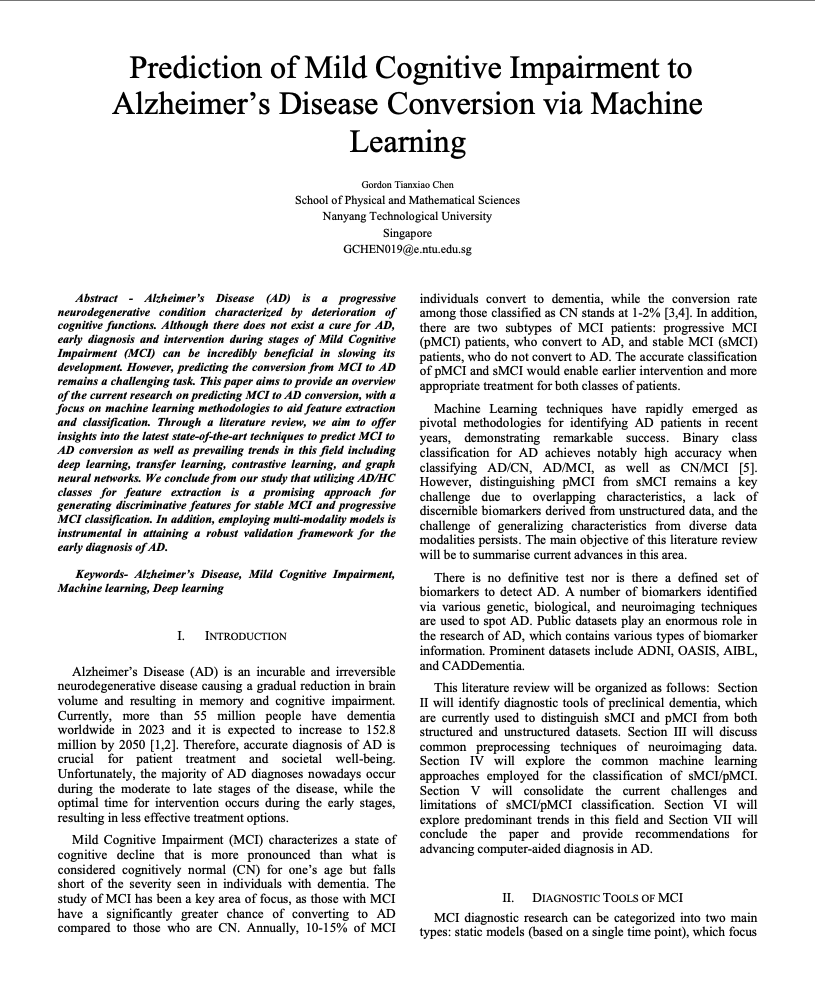
Hello, I'm Gordon! I was born in New Zealand and am currently studying in Singapore. I'm now a Senior Mathematics and Computer Science student at Nanyang Technological University. I am a highly motivated and determined individual and I am incredibly passionate about exploring true Artificial Intelligence to solve real-world problems.
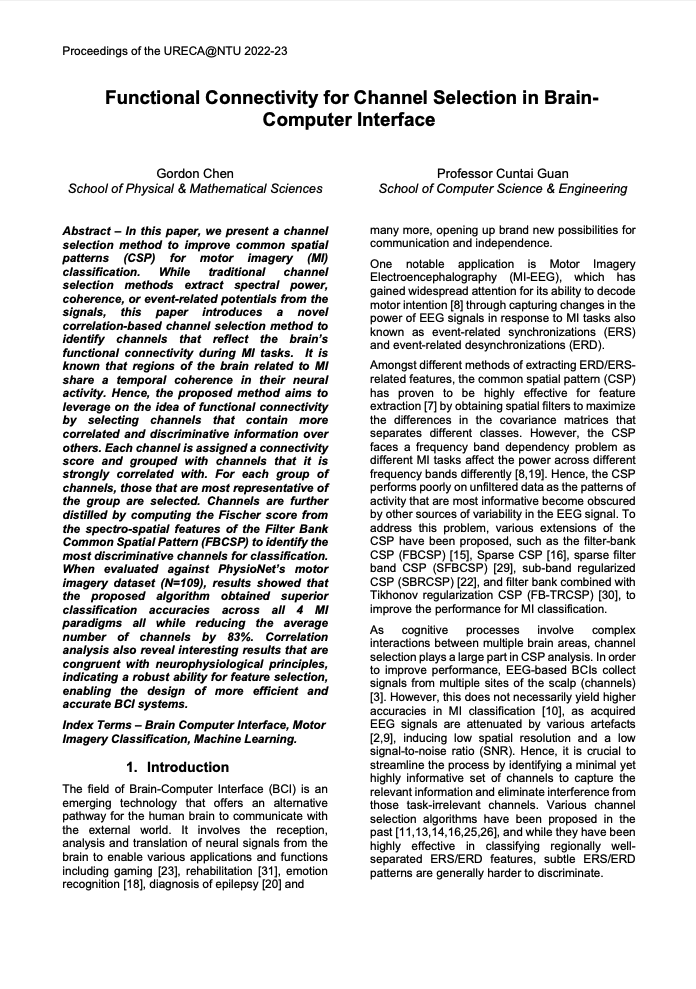
My research interests are image/video editing/generation, vision-language models, and multimodal learning. I look forward to pursuing a Ph.D. in computer vision to delve deeper into this fascinating field.
What i'm doing
-

Learning
Taking Machine Learning, Advanced Topics in Algorithms, Stochastic Processes and Operating Systems this semester.
-

Research @ A*STAR
Text-conditioned non-rigid image editing
Recommendation Letters
-

Mark Volgelsberger (Professor @ MIT)
I’m writing this letter to assist you in understanding Gordon Tianxiao CHEN’s performance in the Machine Learning and Data Science Online Research Seminar. I’ve included a program summary for your reference and to provide you with an idea of what the student has accomplished in this program.
The program covered the concepts in machine learning and data science with a focus on application development. Specifically, students have learned about the most common Python frameworks like Scikit-learn, TensorFlow, Keras, and PyTorch. The students have implemented a wide range of machine learning algorithms in these frameworks with a focus on deep learning and neural networks. Students have, for example, implemented different forms of recurrent neural networks (LSTM, GRU), and generative adversarial neural networks. In addition, they have also learned about GPUs, TPUs, and the basics of big data processing with Hadoop and Apache Spark. Students were asked to complete a Python programming assignment throughout the program individually, which contains three main parts: theoretical derivation of algorithms, code implementation of algorithms, and conducting experiments with coding. The purpose of the assignment is to provide students with a chance to apply what they have learned in class to real problems and to help them lay a solid foundation for the final project. For the final project, the students had to implement a larger neural network application using generative adversarial networks including a graphical user interface using TensorFlow/Keras and PyTorch.
Overall, Gordon Tianxiao CHEN’s performance in this program was Excellent.
It was obvious that Gordon was driven by his interest in the topic, who carefully followed the debate in class. By sharing his personal experience and views with the group, he not only energized the class discussion but also exhibited the ability to think reflectively about problems. The comments he made in the class manifested that he was able to look at problems through a critical lens.
In addition to his participation, Gordon was always able to hand in homework on time. While being able to think independently on homework questions, the written format was very clear and precise. The explanation of the answers was complete and addressed every aspect of the questions.
All students in this program need to complete a final project with two portions, an oral presentation, and a written report. Their group’s project was about CycleGAN-based image translation. The presentation was comprehensive and well organized, describing the background, model, and experiments. The group performed complete experiments and studied the loss function. The expression was clear and fluent. Further exploration and more comparison experiments can make it much better. Gordon was responsible for the CycleGAN model and experiments in the final project. He introduced the dataset and experiments in the presentation and delivered a good analysis of the results. He has completed this part on time and delivered high-quality work in oral presentation with clear expressions. Through the presentation and research report, we can find his good understanding of CycleGAN, which could demonstrate that he delved into this domain and studied a lot. As the leader of the group, Gordon managed to create a team-oriented environment. His performance was professional and confident.
I hope Gordon Tianxiao CHEN can pursue further study in this field. If there are any specific questions I can answer about Gordon Tianxiao’s performance in my program, please feel free to contact me.
Sincerely,
Mark Vogelsberger
Associate Professor
Massachusetts Institute of Technology -

Prabhu Nutakki
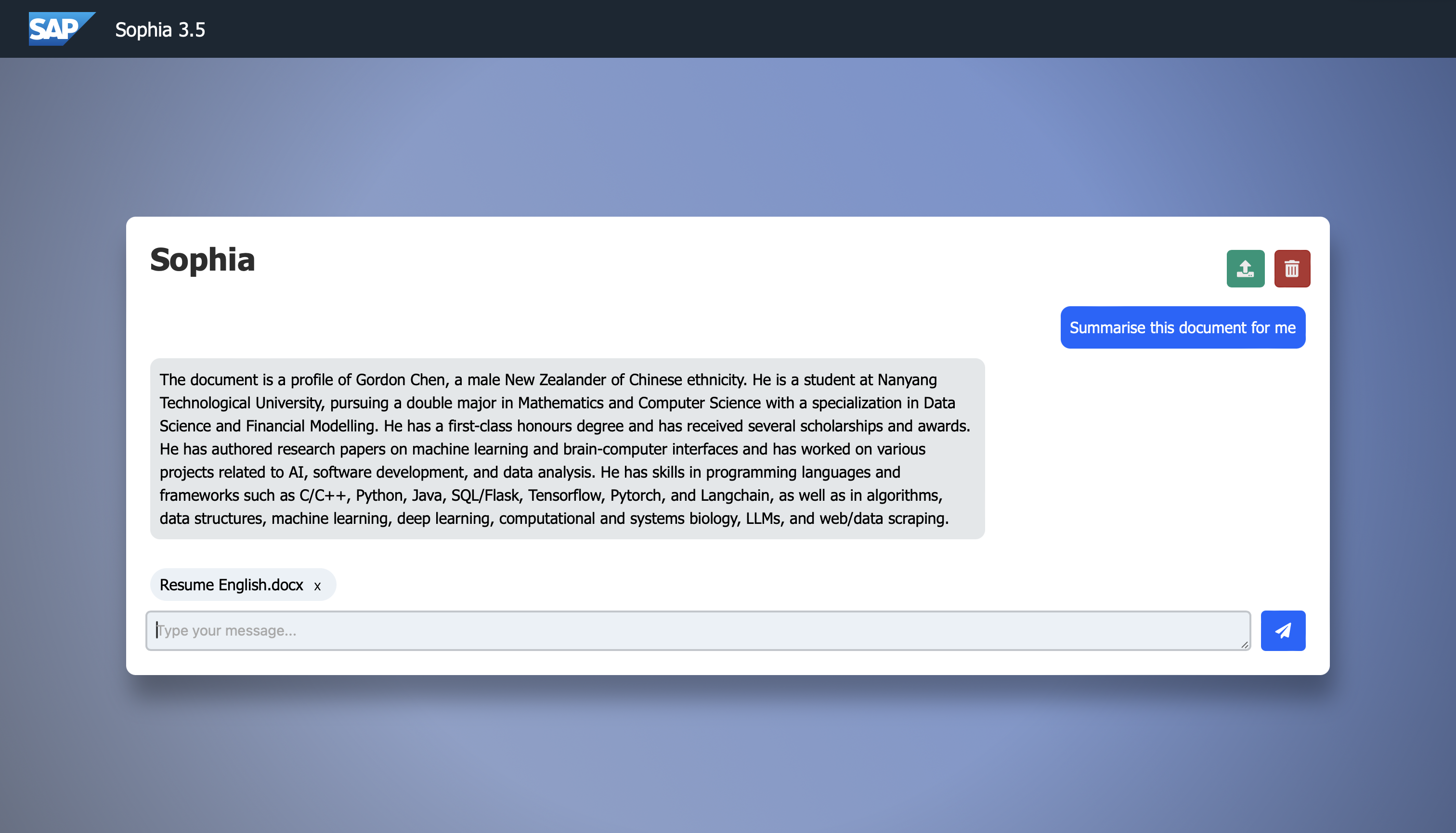
(Principal AI Engineer @ SAP)Gordon Tian Xiao Chen completed a successful NTU Professional internship at SAP from January 2nd, 2024 to June 9th, 2024. As a member of the Workforce Solutions Innovations Product team, he made significant contributions to AI projects, including the AI Job Marketplace and a Chatbot that supports document parsing and multimedia input. Gordon demonstrated strong technical expertise, appetite to research, quickly understanding complex tasks and providing innovative solutions. His work consistently met high quality standards, reflecting his commitment to excellence. He also did guide other interns in his team as and when needed.
In addition to his technical skills, Gordon was a valuable team player due to his collaborative nature and effective communication. His positive attitude and dedication enabled him to deliver tangible results on time. In summary, Gordon is a highly capable individual with a strong combi'rtation of technical and professional skills. I am confident that he will continue to excel at studies and work and I recommend him without reservation for any future role or assignment. ·•
Yours faithfully,
IT Expert Product Owner / Principal AI Engineer
Prabhu Chaitanya Nutakki -

Chan Heng Song (Professor @ NTU)
I am writing to confirm that Chen Gordon Tian Xiao served as an undergraduate Teaching Assistant (TA) in the Division of Mathematics Sciences at the School of Physical and Mathematical Sciences. In Semester 1 of AY2023/34, he served as the tutor for tutorial groups T2 and T8 of MH1100 Calculus. In Semester 2 of AY2023/24, he served as the tutor for tutorial group T4 of MH1301 Discrete Mathematics.
I am the course coordinator for MH1301 Discrete Mathematics and Chen provided valuable assistance as a tutor. Gordon's contributions to the course were invaluable. Throughout the term, Gordon displayed exceptional dedication and proficiency in his role. He has also received excellent scores on his SFT (Student Feedback on Teaching). Students commented that he “communicates concepts and ideas very well, made the class enjoyable”, “give extra questions to the class to make us think abit more”, and is “approachable, willing to teach , he teaches well and he is very nice :)”. Please feel free to contact me if you require any further information.
Yours faithfully,
Assoc Prof Song Heng CHAN
Division of Mathematical Sciences
Nanyang Technological University